// TUBE NEWS
Paper Cores vs. Paper Tubes: What’s the Difference?
If you’ve ever sent a purchase order that said “paper tube” and received something that didn’t work on your winding equipment, you already know the stakes. The confusion around paper core vs paper tube costs buyers real time — wrong diameters, wrong walls, wrong load ratings, cores that collapse mid-run. The terms get used interchangeably in conversation, but in manufacturing they are not the same thing. Knowing the difference helps you write a tighter spec, ask better questions of your supplier, and get the right product the first time.
What Is a Paper Core? (And Why the Definition Matters)
A paper core is a spiral-wound cylinder designed primarily to serve as a winding mandrel — the center around which something else is wound, layered, or converted. Label stock, tape, film, yarn, coated fabric, nonwoven material: all of these travel through a process that starts and ends on a core. The core carries the web or spool under tension, then supports the finished roll during storage and shipment.
Because a core’s job is to hold a load from the outside in — radial compression from the wound material — the spec that matters most is resistance to that compressive force. Wall thickness and the paperboard plies that make it up determine how much load the core can absorb before it deflects or collapses.
At NHPT, “core” and “tube” are used interchangeably — both are spiral-wound to the same dimensional range (.030″–.500″ wall, 1″–8″ ID, .25″–300″ length), and the right product for your application is determined by your spec, not the label on the purchase order.
In practical terms, what is a paper core? It is a precision-wound cylinder where the inside diameter must mate with your mandrel or chuck, the outside diameter must clear your roll OD, and the wall must be stiff enough to survive your process without the core going out-of-round.
Explore NHPT’s paper core lineup to see how standard and custom dimensions are handled for converters, mills, and tissue producers.
What Is an Industrial Paper Tube?
A spiral wound paper tube is built on the same winding technology as a core, but the design intent shifts. Where a core is wound to a winding spec, a tube is often wound to a structural or containment spec. The wall is typically heavier, the paperboard selection may differ, and the end-use could be entirely unrelated to roll-winding — think mailing tubes, composite cans, concrete forms, shipping cylinders, or protective sleeves for wide-format media.
The distinction breaks down like this:
- Cores center on inside diameter accuracy and radial strength for winding applications.
- Tubes center on overall structural integrity, length, and sometimes end-use appearance or printability.
That said, the line is not absolute. A heavy-wall tube used as a winding mandrel for rope or cordage is functionally a core. A thin-wall core used as a mailing tube is functionally a tube. What matters is the spec that drives the design — not the word on the purchase order.
NHPT produces both across a wide dimensional range: inside diameters from 1″ to 8″, wall thicknesses from .030″ to .500″, and lengths from .25″ to 300″. That range covers most converter cores on the light end and heavy structural applications on the thick end.
How to Spec the Right Product for Your Operation
Whether you’re buying for a label press, a tissue line, a yarn winder, or a shipping department, the spec conversation comes down to the same four questions:
- Inside diameter — What mandrel, chuck, or shaft does this need to fit? Tolerance matters here; a sloppy fit causes runout.
- Wall thickness — How much radial load will the wound material impose? Heavier, denser, or higher-tension winds demand more wall.
- Length — What is your finished roll width or shipping length requirement? Custom cutting is standard.
- Volume and cadence — How many do you need and how often? This determines whether a stock program or a dedicated production run makes more sense.
If you know all four, you have a viable spec. If you’re unsure about wall thickness or load requirements, a manufacturer with real application experience can work backward from your process conditions. That’s a conversation, not a form — and it’s worth having before you commit to inventory.
View the full NHPT product range to see how these dimensions map to industries served.
Why Source Your Paper Cores and Tubes from NH Paper Tube?
New Hampshire Paper Tube is a B2B manufacturer in Raymond, NH, with over 50 years of combined team experience in the paper-tube industry. Every core and tube is spiral-wound from 100% recycled paperboard, and 100% of production waste is recycled at the plant — so cores you buy are also recyclable at end of life.
NHPT serves converters, mills, textile operations, flexible packaging lines, and distributors across New England — NH, MA, CT, ME, VT, and RI — with freight lanes that deliver in one to two days. New Hampshire’s tax-free status means no sales tax on your order. Custom manufacturing to spec, in-house logo and artwork printing, and a stock program for large-volume customers are all available — stock ships same day with 24-hour delivery across New England, custom orders run about 5–7 business days, and emergency expedite is available for a small fee. $1,000 minimum order. Inside diameters run 1″ to 8″, wall thicknesses from .030″ to .500″, and lengths from .25″ to 300″ — with free samples so you can confirm fit before you commit.
Request a quote or call 603-693-6136.
Related reading: “Paper Core Crush Strength: How to Spec It (and Why Cores Fail)” · “Tape and Label Cores: Specs, Sizes, and Selection.”
// TUBE NEWS
Paper Core Crush Strength: How to Spec It (and Why Cores Fail)
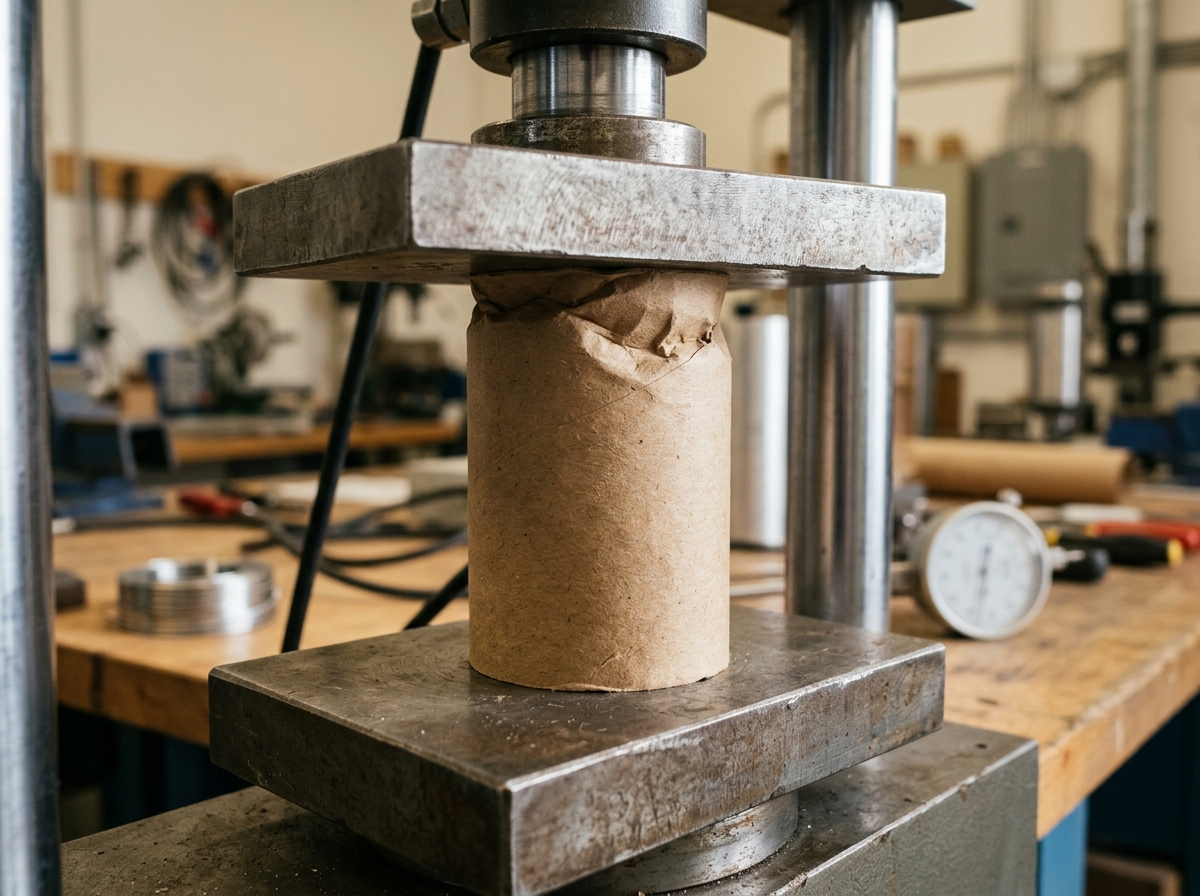
A core that collapses on the winder does not fail quietly. It stops the line, scraps the roll, and costs your team hours you do not have. Most core failures trace back to a single root cause: paper core crush strength was never properly specified for the actual load the core would carry. This article walks through how crush strength works, what drives it, and how to get the spec right before you order.
What Paper Core Crush Strength Actually Measures
Crush strength — sometimes called flat crush resistance — is the load a paper core can sustain radially before it deforms or collapses. In a flat crush test, a core sample is compressed between two parallel plates and the peak load at failure is recorded. Cores are typically evaluated with a flat-crush or radial-crush test; some mills and converters reference an industry standard, while others specify their own in-house procedure.
The number matters because winders, slitters, and rewind stands apply radial force to the core every time tension is taken up in the roll. A core that meets your wall-thickness requirement on paper but was built from lower-density plies will fail at a load your machinery hits routinely.
The Variables That Drive Crush Strength
Four factors control how much radial load a spiral-wound core can take:
- Wall thickness. More wall means more plies, which means more material to absorb radial force. NHPT manufactures to wall thicknesses from .030″ to .500″ — a range wide enough to cover lightweight tissue cores at one end and heavy industrial mandrel cores at the other. See the core ID/OD and wall-thickness reference chart to cross-reference bore size with common wall options.
- Paperboard grade and density. Not all recycled paperboard is equal. Ply adhesion, caliper consistency, and basis weight all affect how plies behave under load. A core wound from higher-density plies at the same nominal wall will outperform a lighter-stock core — which is why grade selection is part of the engineering conversation, not an afterthought.
- Inside diameter. A 3″ core and a 6″ core wound to the same wall thickness do not carry the same load. The larger the bore, the more leverage radial force has, and the harder the core has to work to resist deformation.
- Winding angle and adhesive system. In spiral-wound construction, the angle at which each ply is applied and the adhesive holding plies together both influence how load transfers through the wall. This is where manufacturing process quality shows up in finished-core performance.
If you are uncertain which combination fits your application, the team at NHPT has more than 50 years of combined paper-tube industry experience and can walk through the load case with you. Learn more about custom engineering options.
Why Cores Fail — and the Spec Mistakes That Cause It
The most common spec mistake is copying a core dimension from a previous supplier without asking what the crush strength behind that dimension actually was. Wall thickness and inside diameter are geometry; crush strength is performance. They are related but not the same thing.
A few failure patterns that appear regularly on the floor:
Undersized wall for the roll weight. A plant switches to a lower-cost core with the same ID but thinner wall and finds cores telescoping or buckling mid-roll. The fix is usually a wall increase or a move to a denser ply, not just a change of vendor.
Wrong ID for the mandrel. A core that fits too loosely on the mandrel will rock under tension, concentrating load at the edges rather than distributing it across the full bore. This creates local crush points that look like a strength failure but are actually a dimensional one.
No flat crush test requirement in the purchase spec. If your PO specifies only ID, OD, and length, you have no documented floor on what you will receive. Adding a minimum flat crush value — with a test method — gives you an acceptance criterion and gives your supplier a target. For a deeper look at paper core crush strength engineering principles, including how to calculate load requirements for your application, that page is a useful reference.
Sourcing Crush-Rated Cores from New Hampshire Paper Tube
NH Paper Tube is a custom B2B manufacturer of spiral-wound paper tubes and cores based in Raymond, New Hampshire, serving converters, mills, and plant operations throughout New England — including NH, MA, CT, ME, VT, and RI. Every core is made from 100% recycled paperboard, and NHPT recycles 100% of its production waste; finished cores are fully recyclable at end of use.
NHPT manufactures to inside diameters from 1″ to 8″, wall thicknesses from .030″ to .500″, and lengths from .25″ to 300″, with production capacity in the millions of cores per month. The $1,000 minimum order applies to all runs. Stock cores ship same day, with delivery across New England within 24 hours; custom orders are typically ready in about 5–7 business days, and emergency expedite is available for a small fee. New Hampshire’s no-sales-tax status and short one-to-two-day freight lanes into the Northeast keep landed cost competitive. Free samples are available before you commit to a run.
Request a quote or call 603-693-6136.
Related reading: “Paper Cores vs. Paper Tubes: What’s the Difference?” · “Why Paper Cores Fail on the Winder (and How to Prevent It)”
// TUBE NEWS
6 Advantages of Paper Tube Packaging
6 Advantages of Paper Tube Packaging
oz • January 18, 2021
Sir Malcolm Thornhill, a British industrialist, is widely credited for making the first retail cardboard box in 1817. By 1840, cardboard boxes became popular in France for transporting moth eggs from Japan. Today, because of their durability, lightweight, and cost-effectiveness, cardboard tubes boxes and paper tubes are the most widely used packaging materials by businesses. Paper tubes are an eco-friendly alternative with multiple retail applications for all kinds of businesses. Here, we give you seven reasons why your company should use paper tubes for packaging.
Safe and durable
Paper tube packaging provides safe cushioning to fragile items and reduces the chances of damage during transport. It also shields them against external weather elements, like sunlight and wind. It is their dependable safety and durability that is making paper tubes increasingly popular in the cosmetic and pharma industries.
Eco-friendly
The packaging industry is moving towards more sustainable options, and paper tubes are 100% eco-friendly. They are biodegradable and recyclable, saving energy and resources that you would have otherwise needed for fresh packaging. Using eco-friendly packaging will provide your business with a competitive edge in the market and reduce your carbon footprint.
Lightweight and easy to transport
Unlike packaging materials made of plastic, wood, and metal, paper tubes are lightweight and easy to transport. As you can stack multiple tubes one above another, they take much less space during transportation.
Safe for food packaging
Plastic is unsafe for packaging food, as the inner lining can react with the contents and contaminate it. Heating food packed in plastic in a microwave further increases the risk of contamination. Meanwhile, paper tubes are chemically inert and do not react with food, making them a safe packaging alternative for edible items. They also keep the food fresh. Snacks, candy, and coffee are some food items suitable for paper tube packaging.
Cost-effective
Paper tubes have the lowest packaging cost compared to other alternatives, as their manufacturing is not labor or capital intensive. You can further reduce the manufacturing cost by using recycled post-consumer paperboard instead of a first-use (virgin) fiberboard.
Low packaging cost will help increase your company’s profits and overall ROI. A reduction in product price because of lower packaging costs can also help you gain a competitive advantage.
Highly customizable
Packaging plays a crucial role in shaping customer purchase decisions, serving as the first interaction between your product and the buyer. Paper tubes offer excellent customization options, allowing brands to add vibrant colors, unique designs, and strong branding elements that create a memorable impact. A custom paper tube company can also tailor the shape and size of the tubes to perfectly meet your specific product needs.
About New Hampshire Paper Tube
From color tubes to spool and reel cores, we make all kinds of paper tubes. We also provide custom paper tubes and cores, mailing, and textile paper tube. If you have questions about our products, you can call us at (603) 706-6255 or email us at matt@nhpapertube.com. You can also fill out our online contact form, and we will get in touch with you.
What Are Paper Tubes Made Of and Why Recycled Paper Matters
How to Choose the Right Diameter for Mailing Tubes
Spiral Paper Tubes Explained: Strength, Uses, and Applications
Custom vs Standard Paper Tubes for Business Packaging
How to Choose a Paper Tube Manufacturer in New England
How Many Types of Paper Tubes are There?
What are Paper Tubes Made Of?
Where Should I Look for Custom Paper Tubes in the New England Area?
Which Packaging is Best for Shipping and Mailing?
Top 8 Benefits of Custom Paper Tubes
// TUBE NEWS
Need for Custom Paper Tubes and Cores-
All About Custom Paper Tubes and Cores
oz • June 29, 2021
Every company has a different requirement of paper tubes and cores for their various products. Custom paper tubes and cores are preferable over regular paper tubes as they are exclusively designed for a particular product and to suit a specific function. They can be customized in innumerable ways, from various characters and filters to precisely match how a company wants to represent its brand.
Need for Custom Paper Tubes and Cores-
Brand It!
Whether used for packaging material in them or over them, custom tubes can be designed with a brand tag, allowing the company to promote itself. The placement of the name can be chosen according to the product or wish of the user.
Specificity
Custom cardboard tubes and cores are specifically designed for your needs. The length, width, thickness, strength, everything is particularized by you whether it is used to pack wines or cosmetics or used as cores for threads. The provider will also make sure that the order can be repeated whenever needed.
Stylize, Make a Statement, and Stand Out-
A custom paper tube company can help you make a statement and stand out with unique finishes like color printing. This helps pop out your brand among the other dull, pre-made paper tubes.
Unique!
Custom paper tubes allow you to be unique and stand out from the ordinary. They represent you and your brand from the inside out. They are made out of the material of your choice apart from the traditional materials.
Sustainable Choice-
They are sustainable and eco-friendly, made out of recycled paper. They help the environment along with caring for your brand image. They are lightweight, flexible, durable, recyclable, and reusable.
Suit Your Purpose-
Paper tubes are available in different variants based on purpose and function. There are shipping or mailing tubes, spiral wound paper cores, kraft tubes, sonotubes, and many others to fit your needs. They can be used as containers to post documents or art or can be used to wrap things around them.
Different Aspects of Customization-
- Function of the tube,
- The durability of the tube,
- Desired width and length,
- Type of tube required,
- Design of the tube,
- Cardboard thickness,
- Decorative foils or paper coatings,
- Colors and patterns,
- Product information to be added,
- Labels and logos to be added,
- If ends are sealed or not
About New Hampshire Paper Tube
If you are looking for an eco-friendly paper tube manufacturer, New Hampshire Paper Tube should be your one-stop destination. 98% of our raw material is recycled paper. From color tubes to spool and reel cores, we make all kinds of paper tubes.
We also provide custom paper tubes and cores, mailing, and textile paper tube. You can call us at (603) 706-6255 or email us at office@nhpapertbe.com to know more. You can also fill out our online contact form, and we will get in touch with you.
What Are Paper Tubes Made Of and Why Recycled Paper Matters
How to Choose the Right Diameter for Mailing Tubes
Spiral Paper Tubes Explained: Strength, Uses, and Applications
Custom vs Standard Paper Tubes for Business Packaging
How to Choose a Paper Tube Manufacturer in New England
How Many Types of Paper Tubes are There?
What are Paper Tubes Made Of?
Where Should I Look for Custom Paper Tubes in the New England Area?
Which Packaging is Best for Shipping and Mailing?
Top 8 Benefits of Custom Paper Tubes
// TUBE NEWS
DIY desk organizer
3 Amazing and Fun Toilet Paper Roll Crafts
May 24, 2021
Americans are the highest consumers of toilet paper rolls in the world — 34 million rolls per day and about 36.5 billion rolls per annum. It takes about 270,000 trees and 17.3 terawatts of electricity annually to produce that much toilet paper. These staggering numbers emphasize the need to recycle toilet paper rolls. It’s not just toilet paper that can be recycled, you can also use the empty toilet paper rolls, which are essentially made of cardboard for various purposes. Here are three fun and innovative DIY craft ideas to recycle empty toilet paper rolls:
DIY desk organizer
A DIY desk organizer with toilet paper rolls is an easy way to fix the mess created by kids’ stationery.
Things you need
- Cereal boxes and toilet paper rolls
- Acrylic paint
- Ribbons (color coordinated)
- Craft essentials (Scissors, glue, knife, and ruler)
- Colored paper
Steps:
- Take 2-3 empty cereal boxes and cut them at one-fourth length from the bottom to make the front row of your organizer. Take another two boxes and cut them in half for the back row.
- Attach the toilet paper rolls to each other with glue to create spiral tubes of different lengths.
- Place the longer tubes into the back row and the smaller ones in the front row cereal boxes.
- Once the structure is ready, cover each individual piece with colorful paper using glue. Add the ribbons to the tops of the spiral tubes. You can paint beautiful motifs on the boxes with acrylic paint.
- Once everything dries, fix them in the original structure design using glue and tape.
Halloween bats
This Halloween decorate your home with these, not so creepy Halloween bats made with toilet paper rolls.
- Empty toilet paper rolls
- Black paint and paper
- Googly eyes
- Craft essentials
Steps to make
- Take the toilet paper rolls and paint them black using acrylic colors.
- Take the black paper and cut out bat wings from it: two wings per roll.
- Flatten the paper, roll, and fold both the ends of the tubes to the inside.
- Paste the wings on one side and stick the googly eyes on the opposite side to finish the job.
Phone Holder
A DIY phone holder is efficient, cheap, and eco-friendly. Here is how you can make one:
- Toilet paper rolls
- Washi paper (you can also use fabric or wool)
- Pushpins and craft essentials
- Take an empty toilet paper roll and make a cutout on the surface the size of your phone. You can make one cut out as per vertical length and the other as per the horizontal length of your phone.
- Cover the rolls with Washi paper and any other decoration you may like to make them attractive.
- Attach the pushpins on the four sides to create a make-shift stand.
About New Hampshire Paper Tube
If you are looking for an eco-friendly paper tube manufacturer, New Hampshire Paper Tube should be your one-stop destination. 98% of our raw material is recycled paper. From color tubes to spool and reel cores, we make all kinds of paper tubes.
We also provide custom paper tubes and cores, mailing, and textile tubes. You can call us at (603) 706-6255 or email us at office@nhpapertbe.com to know more. You can also fill out our online contact form, and we will get in touch with you.
What Are Paper Tubes Made Of and Why Recycled Paper Matters
How to Choose the Right Diameter for Mailing Tubes
Spiral Paper Tubes Explained: Strength, Uses, and Applications
Custom vs Standard Paper Tubes for Business Packaging
How to Choose a Paper Tube Manufacturer in New England
How Many Types of Paper Tubes are There?
What are Paper Tubes Made Of?
Where Should I Look for Custom Paper Tubes in the New England Area?
Which Packaging is Best for Shipping and Mailing?
Top 8 Benefits of Custom Paper Tubes
// TUBE NEWS
Benefits of Using Paper Tubes
Are Paper Tubes Recyclable?
oz • January 31, 2022
Amongst the multiple advantages and applications that a single paper tube can hold, there comes the one that has the potential of increasing paper tube demands in the market. And it is that paper tubes are recyclable. You can also reuse and upcycle them after they have completed their primary purpose as holding tubes for toilet paper, kitchen paper, paper towels, and mailing tubes for delicate and specialty items.
Here is all you need to know about paper tubes.
Benefits of Using Paper Tubes
Paper tubes are widely used today for various purposes, from industries to household and delicate materials to construction support. But it is interesting to know how such a simple product can become such an elementary part of our lives in a very short amount of time.
Here are some benefits of using paper tubes in our daily lives:
- They are reusable: You can create many craft projects using paper tubes and cores. For example, a bird feeder!
- They are safe and durable: The thick paper layers in a paper tube keep fragile items inside secure by providing a cushioning effect.
- They are 100% eco-friendly: Along with following every R of the 3R’s (recycling, reusing, and reducing), paper tubes and cores offer eco-friendliness to their users with their biodegradability.
- They are efficient: A majority of cardboard tubes manufactured today use recycled paper as primary raw material. This efficient usage reduces the energy and resources that go into manufacturing paper tubes from virgin papers.
- They reduce deforestation: They are majorly manufactured with used paper and paper products. Hence their usage significantly reduces the number of trees cut down to manufacture paper.
Why You Should Recycle Paper Tubes
While there should be no reason for recycling a potential item, here are a few reasons to convince you to recycle paper tubes:
- With their multiple applications in everyday lives, paper tubes are being manufactured at a high rate, increasing waste materials into nature.
- It helps you take one step towards saving the environment by reducing the number of new trees cut down in the manufacturing processes.
- You will help create more landfill space by reducing garbage.
- You can reduce air pollution and the production of methane gas that occurs as a result of dumping papers in landfills.
- Recycling saves water as it takes 35,000 liters less water to produce one tonne of recycled paper than an equal amount of virgin paper.
- It increases your goodwill since most environment protection organizations, such as WWE, endorse recycling.
How You Can Recycle Paper Tubes
If you believe you cannot reuse paper tubes because they have lost their structural integrity, you can send them in for recycling. Most landfills recycle paper and its products themselves. But you need to make sure that you throw paper tubes in the recycling bin and not the regular garbage bin.
About New Hampshire Paper Tube
Looking for high-quality paper tubes made with recycled materials? At New Hampshire Paper Tube, we specialize in high-quality spiral paper tube manufacturer–from color tubes to spool and reel cores.
If you have any questions regarding our products, services, or paper tubes, feel free to contact us at (603) 706-6255 or email us at matt@nhpapertube.com. You can also complete our online contact form to learn more about our custom paper tube solutions.
What Are Paper Tubes Made Of and Why Recycled Paper Matters
How to Choose the Right Diameter for Mailing Tubes
Spiral Paper Tubes Explained: Strength, Uses, and Applications
Custom vs Standard Paper Tubes for Business Packaging
How to Choose a Paper Tube Manufacturer in New England
How Many Types of Paper Tubes are There?
What are Paper Tubes Made Of?
Where Should I Look for Custom Paper Tubes in the New England Area?
Which Packaging is Best for Shipping and Mailing?
Top 8 Benefits of Custom Paper Tubes
// TUBE NEWS
6 DIY products you can make from cardboard tubes
6 Brilliant Ways to Use Leftover Cardboard Tubes
oz • December 21, 2020
Cardboard paper tubes are so standard you can see them every day in your house in toilet paper rolls, foil rolls, map holders, and many other things. But most of the time, we throw them away after using the product. However, you can recycle those tubes to create some handy and creative DIY crafts. It is fun and productive and also helps save the environment by reducing waste and cutting trees.
6 DIY products you can make from cardboard tubes
Keep your cords untangled: All of us have cables in a tangled mess. You can sort them quickly by running them through leftover cardboard tubes. It will prevent them from forming nasty knots. You can also store your small detachable cords for different electronics in an organized manner by making a cardboard tube organizer. It’s time to bid farewell to hours of messy untangling.
Make your seed starters at home: If you enjoy gardening but prefer not to spend on seed starters for young plants, toilet paper tubes can be a simple and cost-effective solution. Just cut the tubes in half, arrange them in a waterproof tray, fill them with potting soil, and plant your seeds. After they sprout, you can remove the tubes from the tray and place them directly into the soil or pots. A paper tube company can also provide eco-friendly options ideal for this purpose.
Keep your dress pants crease-free: Nothing spoils the mood worse than a crease on your ready-to-wear dress pants hanging in the wardrobe. There is a quick solution to this problem. You simply need to take a cardboard paper tube, cut down its length using sharp scissors, and slip it on the hanger’s horizontal bar. It will prevent the creases from forming on pants. You can fix the paper tube with tape to prevent it from slipping off the hanger.
Turn empty Pringle box into speakers: Do you love eating those tasty potato chips and have many empty boxes that you will eventually throw away? Save one and convert it into a makeshift speaker. You just need to make a phone-sized cutout in the box and place your phone’s speaker side in it. Switch on the music, and boom.Store your plastic bags like a pro: You need plastic bags to store stuff or provide cover against water. You can now store them neatly in a no-fuss, hassle-free way. All you need to do is take an empty paper towel roll and stuff as many plastic bags as you can into it, and put on the lid. The entire mess vanishes like magic, and you can always take one out whenever you want.
DIY toys and crafts for kids: Children love DIY toys and arts, and you can use empty paper tubes to create various fun crafts for them like a kaleidoscope, Christmas ornaments, paper-tube dinosaur, and much more. Making them can be a great fun and learning experience for both you and them.
About New Hampshire Paper Tube
Do you wonder where all these per tubes come from? It’s people like us who produce them. At New Hampshire Paper Tube, we make all kinds, from color tubes to spool and reel cores. If you have questions about our products, services, or paper tubes, you can reach out to us by calling at (603) 706-6255 or emailing us at matt@nhpapertube.com. Or you can also fill out our online contact form.
What Are Paper Tubes Made Of and Why Recycled Paper Matters
How to Choose the Right Diameter for Mailing Tubes
Spiral Paper Tubes Explained: Strength, Uses, and Applications
Custom vs Standard Paper Tubes for Business Packaging
How to Choose a Paper Tube Manufacturer in New England
How Many Types of Paper Tubes are There?
What are Paper Tubes Made Of?
Where Should I Look for Custom Paper Tubes in the New England Area?
Which Packaging is Best for Shipping and Mailing?
Top 8 Benefits of Custom Paper Tubes
// TUBE NEWS
Let us have a look at a few characteristics of high-quality – paper tubes
5 Characteristics of High-Quality Paper Tubes
oz • December 9, 2021
Paper tubes and core are among some of the most popular packaging materials today. You can use paper tubes for cosmetic wrapping purposes, as well as for transporting special equipment like telescopes and medical devices.
However, their utility does not end just there.
You can reuse them multiple times before sending them for recycling. Whether you have a large industry or a small-scale business-to-customer company, using high-quality cardboard tubes ensures you get your money’s worth.
Let us have a look at a few characteristics of high-quality paper tubes
- They are Biodegradable: High-quality custom paper tube company are manufactured using biodegradable materials like recycled papers, cardboards, and wood pulp fibers. The organic raw material also makes them eco-friendly and recyclable. They are also lightweight, allowing them to be carried easily from one place to another and transport the packed article safely without any damage. Another notable feature of high-quality paper tubes is their reusability. They do not lose their shape after usage and can be reused for packaging or as raw materials for craft supplies.
- They are Manufactured for a Specific Purpose: Paper tubes are not just meant to ship fragile decorative articles. Many industries manufacture and sell paper tubes following strict regulations, especially in cases of medical, food, photographic, and scientific fields. High-quality paper tubes are manufactured according to the specifications provided by the customer. This is because the special pieces of equipment listed above are quite expensive and cannot be repaired if damaged. Paper tubes used in the medical and food industry need to be safe for packaging edible items. Similarly, paper tubes meant for packaging and transporting photographs need to be double-coated for minimizing light exposure, as light can damage photographic sheets. Moreover, they emit radiation that can be harmful to people and other equipment. To this end, specially crafted paper tubes are lined with absorbing dark sheets to prevent the radiation from leaking.
- They are Resistant to Compression: Paper tubes are made up of multiple layers which makes them thick to avoid any bending. Adding strength to the bottom and outer layers is more of a challenge. Paper tubes are shock-absorbent and retain their shape, preventing the packed articles from getting damaged. Any particular layer required by the customer is added as the innermost layer for further customizing the use of paper tubes.
- They Have High Technical Specifications: The greatest advantage of using paper tubes is their customization options. You can order the manufacturer to design paper tubes precisely according to your standard dimensions to fit the article perfectly. They also have a consistent width throughout. You can also add your company names, logo, and color code for branding customization.
- They Have Multiple Uses: High-quality paper tubes don’t get wasted in the first use. You can reuse them to transport your product multiple times, as they are recyclable, reusable, and thus can be easily upcycled. Your customers can also reuse them for numerous purposes like storing and organizing if you sell products directly to them.
About New Hampshire Paper Tube
Do you want high-quality cardboard tubes and cores to ship your products safely without damaging them? At New Hampshire Paper Tube, we specialize in manufacturing high-quality paper tubes–from color tubes to spool and reel cores.
If you have questions about our products, services, or paper tubes, you can reach out to us at (603) 706-6255 or write to us at matt@nhpapertube.com. Alternatively, you can also fill out our online contact form to know more about our custom paper tube company.
What Are Paper Tubes Made Of and Why Recycled Paper Matters
How to Choose the Right Diameter for Mailing Tubes
Spiral Paper Tubes Explained: Strength, Uses, and Applications
Custom vs Standard Paper Tubes for Business Packaging
How to Choose a Paper Tube Manufacturer in New England
How Many Types of Paper Tubes are There?
What are Paper Tubes Made Of?
Where Should I Look for Custom Paper Tubes in the New England Area?
Which Packaging is Best for Shipping and Mailing?
Top 8 Benefits of Custom Paper Tubes
// TUBE NEWS
Custom Paper Tubes
A Guide to Custom Paper Tubes
oz • August 3, 2020
Custom Paper Tubes
Depending on your business’s needs, regular paper tubes may not be enough. Thankfully, our tubes can be customized in a number of different ways to match what you’re looking for. Given their strength and versatility, this can help you solve a myriad of different business problems. Below, you’ll learn why so many businesses choose to get custom paper tubes from New Hampshire Paper Tube. We hope this helps open your eyes to the possibilities that paper tubes offer.
Brand Your Tubes
One of the most popular aspects of our custom paper tube company is its ability to represent your business’s brand. Whether you’re shipping an item and want the customer to be impressed — or you want to make sure your customer remembers where they bought their textiles when they’ve reached the end of a roll — branded paper tubes are excellent for helping to keep your business at the front of your customer’s mind. We’ll work with you to determine what will look best on the tube, and we offer customizations for color, size, and printing your logo.
Infinite Possibilities
Along with helping the paper tubes you use match your brand, we’re also happy to design the tubes to match your specifications. We understand the many different uses that paper tubes have, but you may need a certain size or thickness that we don’t usually offer. We have a Research and Development department dedicated to helping people like you, whose needs aren’t met by the current paper tubes available on the market. We’ll take all of your needs into consideration in order to create the perfect paper tube for you. The best part is, once the tube has been designed, you can order it over and over again without having to worry about more R&D.
Stunning Custom Paper Tubes – New Hampshire Paper Tube
If you’re looking for custom paper tube manufacture in the New England area, you’ve come to the right place. New Hampshire Paper Tube has an expertise that can’t be matched. For decades, we’ve been manufacturing paper tubes of all shapes, sizes, and colors. The versatility of textile paper tubes often surprises people, but not us. We have witnessed firsthand how these tubes add a nice touch to businesses of all kinds. Their ability to enhance aesthetics and functionality is truly remarkable. Have any questions about what we can do for you? Ready to get a free quote? You can call us at 603-682-0095, email us at matt@nhpapertube.com, or fill out our online contact form. Please keep in mind that we offer 24/7 emergency services in the event that your business needs cardboard tubes fast.
What Are Paper Tubes Made Of and Why Recycled Paper Matters
How to Choose the Right Diameter for Mailing Tubes
Spiral Paper Tubes Explained: Strength, Uses, and Applications
Custom vs Standard Paper Tubes for Business Packaging
How to Choose a Paper Tube Manufacturer in New England
How Many Types of Paper Tubes are There?
What are Paper Tubes Made Of?
Where Should I Look for Custom Paper Tubes in the New England Area?
Which Packaging is Best for Shipping and Mailing?
Top 8 Benefits of Custom Paper Tubes
// TUBE NEWS
Key Differences Between Custom and Standard Tubes
Custom vs Standard Paper Tubes for Business Packaging
February 20, 2026
Choosing the right paper tubes for your business can impact both product protection and your bottom line. Standard tubes work well for many applications, but custom options offer flexibility that pre-made solutions can’t match. Understanding the difference helps you make the best choice for your needs.
What Are Standard Paper Tubes?
Standard paper tubes are pre-manufactured tubes produced in common sizes and specifications. They’re mass-produced and readily available, making them a convenient option for businesses with typical packaging or shipping needs. Industries like textiles, shipping, and general manufacturing often rely on standard tubes for everyday operations.
What Are Custom Paper Tubes?
Custom paper tubes are manufactured to your exact specifications. A custom paper tube company can adjust dimensions, wall thickness, and material composition to match specific requirements. This approach works well when standard sizes don’t fit your products or when you need specialized strength or branding.
Key Differences Between Custom and Standard Tubes
Understanding how these options compare helps clarify which suits your business best:
- Size and Fit: Standard tubes come in fixed dimensions, while custom tubes are made to order for precise product fit.
- Strength and Durability: Custom manufacturing allows for thicker walls or reinforced construction when needed.
- Flexibility for Specific Applications: Custom tubes can include printed logos, unique end caps, or specialized coatings.
- Cost Considerations: Standard tubes cost less upfront, but custom tubes can reduce waste and improve efficiency over time.
When Standard Tubes Make Sense
Standard tubes are practical for businesses with straightforward needs. If your products fit common dimensions and don’t require special features, standard options offer fast availability and lower costs. They’re ideal for high-volume operations where consistency matters more than customization.
Shipping tubes, textile cores, and general mailing applications often work perfectly with standard sizes. When speed and budget are priorities, standard tubes deliver reliable performance without extra lead time.
When Custom Paper Tubes Are the Better Choice
Custom tubes become essential when standard options fall short. Businesses with unique product dimensions, branding requirements, or specialized performance needs benefit from tailored solutions. A spiral paper tube manufacturer can create stronger, more durable tubes for heavy-duty applications.
Industries like packaging, industrial manufacturing, and specialized shipping often require custom specifications. If your products need precise protection or your brand demands custom printing, working with a paper tube manufacturer that offers customization makes sense.
Make the Right Choice for Your Business
The decision between custom and standard tubes depends on your specific requirements. Standard tubes offer convenience and cost savings for routine applications. Custom tubes provide precision, branding opportunities, and performance advantages when your needs go beyond off-the-shelf solutions.
Ready to explore your options? Visit New Hampshire Paper Tube to learn more about custom manufacturing solutions that fit your business needs.